PasserJack help
Connect Codex
Add PasserJack to Codex with one command, then sign in through your browser.
Signs in through your browser.
Before you start
- A PasserJack account
- Codex CLI installed
- A terminal on the machine you want to connect
Show the visual walkthrough
Step by step
- Run the add command below in a terminal on the computer you want to connect. Codex starts browser sign-in automatically.
- Keep that terminal open and waiting. Open the link Codex prints in a browser on the same computer, and approve access in PasserJack.
- Wait for the terminal to confirm that sign-in succeeded, then start a new Codex session.
What to paste
codex mcp add passerjack --url https://passerjack.com/api/mcp
Trouble signing in?
Sign-in timed out or did not start?
If the add command has finished without signing you in, run this retry command on the same computer. Keep the terminal waiting and use the new authorization link it prints. If another sign-in attempt is still waiting, finish it or cancel it with Ctrl+C before retrying. A successful sign-in does not need another login command.
codex mcp login passerjackThe callback page cannot be reached?
An old browser tab may point to an attempt that has already timed out. Close that tab and use the authorization link from the sign-in attempt currently waiting in your terminal. If that attempt has ended too, retry sign-in above. Use a browser on the same computer as the terminal. Do not refresh or edit the old callback URL.
Use an API key instead
Open Agents and API keys, choose Codex, then expand Use an API key instead to create your key. These examples carry a placeholder.
- No browser on that machine? Open PasserJack, then Settings, then Agents and API keys, choose Codex, expand Use an API key instead, press Create a key and fill this in, and copy the block.
- Run the key command, then put PASSERJACK_API_KEY in your shell profile on macOS and Linux, or set it with setx in PowerShell on Windows. Codex writes ~/.codex/config.toml itself.
- Open a new terminal so the variable is set, then start Codex.
codex mcp add passerjack --url https://passerjack.com/api/mcp --bearer-token-env-var PASSERJACK_API_KEY
# macOS and Linux: ~/.zshrc, ~/.bashrc, or wherever your shell keeps its exports
export PASSERJACK_API_KEY="pj_paste-your-key-here"
# PowerShell, persistent (new terminals)
setx PASSERJACK_API_KEY "pj_paste-your-key-here"
# PowerShell, this terminal only
$env:PASSERJACK_API_KEY = "pj_paste-your-key-here"
Preview the PasserJack screens
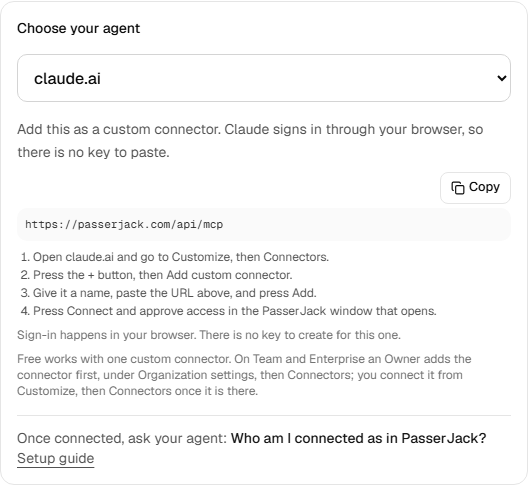
Open Agents and API keys and choose your agent. If you use an API key, each new key is shown exactly once.
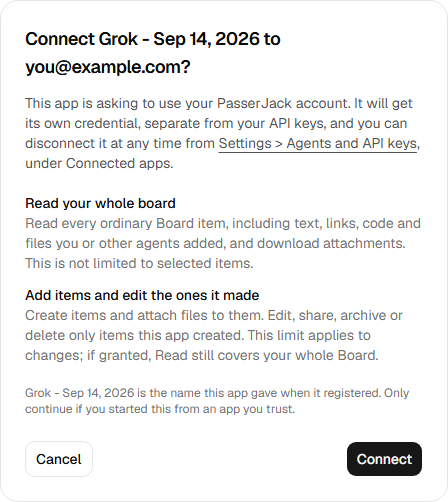
This is the screen a browser sign-in lands on. It names the app that is asking and the permissions it wants, and nothing is granted until you approve it. Read covers your whole ordinary Board, including your attachments. The default edit limit protects items the app did not create from changes; it does not hide them from reads.
Check it worked
Ask the agent: who am I connected as?
A correct answer names your account email, the key or app it is using (for example “Grok - Sep 10, 2026”), and its permissions: read, write if granted, and secrets only if you granted it. If it cannot answer, or names a different account, the connection is not made, so go back through the steps.
Granted write access? Ask it to save a short test note, then confirm that note appears on your board.
Vault reads need both secrets permission and an Unlock for agents window you explicitly open in Vault settings. That permission also includes text and extracted details from sensitive Board images without a Vault window. Review the permission and capture boundaries before granting it.
Manage or disconnect
Open PasserJack, then Settings, then Agents and API keys. That page lists your keys, the apps you have connected and your connector credentials, and you revoke any of them from there.
A revoked key stops working immediately. If a client reports an authentication error, check which account it is signed in to and whether its key was revoked before you create another.